Why Won't This Wound Heal? A Wound Specialist's Guide to Stalled Wounds

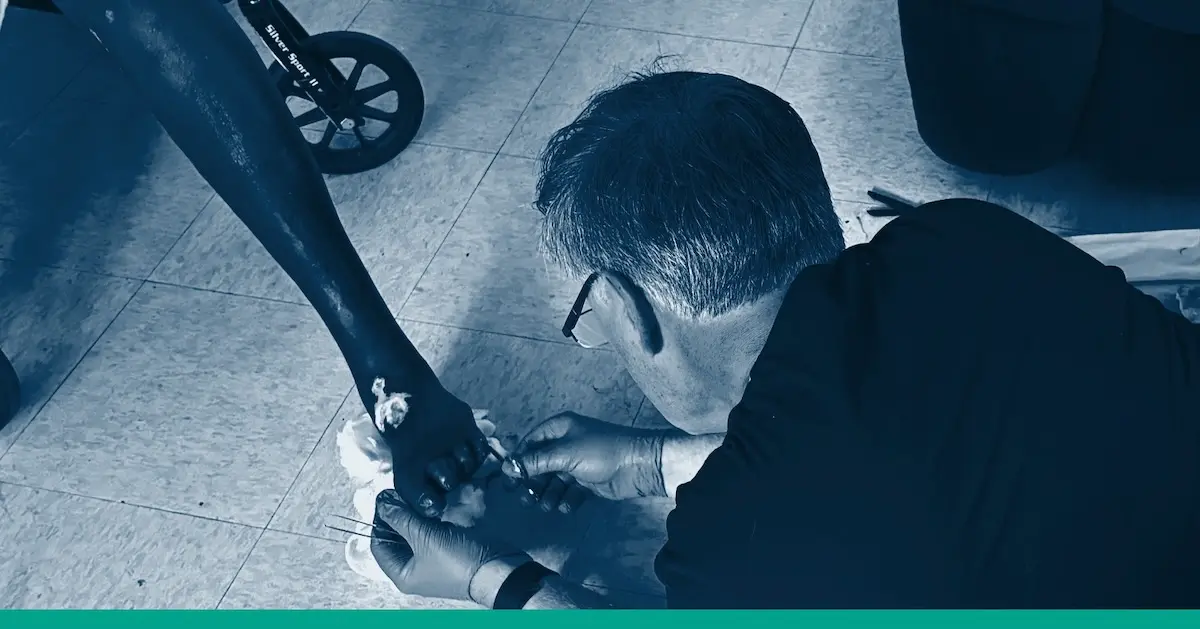
A 72-year-old woman with obesity and chronic venous hypertension developed a medial-ankle ulcer that has lingered for four months. There’s pale granulation. No necrosis. And it hasn’t changed.
It’s stalled.
And it’s stalled despite good care. That pale granulation, after all, shows that something is happening. But in reality, it isn’t.
This is the gap in wound care between looks-like-healing and is-healing.
Now, this isn’t a one-off, unlucky patient. It’s actually a common category of patient.
Chronic wounds persist because they're stuck on a specific cause, one that standard wound care often isn't built to find.
My name is Dr. Lonnie Lassiter, and I’ve spent more than two decades healing wounds on patients, like the one mentioned above.
If a wound is stuck rather than slow, then two things matter more than anything else you do at the bedside.
First, you have to be able to tell the difference, because a slow wound and a stalled one look almost identical until you know how to read them.
Second, once you know a wound is stuck, you have to find what’s holding it there, because until that cause is corrected, no dressing, protocol or amount of patience will close it.
And that’s what this article is all about. I’ll walk you through how I read a wound to understand stalled from slow, the framework I use to find what’s blocking it, and how to know when a stalled wound has moved beyond what any care plan can fix on its own.
Why Won’t a Wound Heal?
A wound stops healing when it gets stuck at one point in the healing process, rather than because it is healing slowly. That distinction determines everything you do next.
A healthy wound moves along a predictable path. Every wound, whatever caused it and wherever it sits on the body, is always somewhere on that path, and the path runs in one direction. It cleans, then it builds, then it closes, on a fairly reliable timeline. When a wound is healing normally, the job at the bedside is mostly to support a process that already has momentum.
A chronic wound stepped off that path and came to a stop. Something is physically holding it in place, and until you find that something and deal with it, the wound stays put no matter how much time passes. That's the whole distinction between a slow wound and a stalled one. A slow wound is still moving, just not quickly. A stalled wound hit a wall, and there's a specific reason for it.
The good news is you can usually track down that reason once you know what you're looking at.
Inside a wound that's stuck, the normal sequence has broken down at the chemical level. In healthy healing, inflammation arrives early to clear damaged tissue and then resolves so rebuilding can begin. In a chronic wound, it never resolves. Immune cells linger in the wound bed and keep releasing enzymes and reactive oxygen species that degrade the structural proteins and growth factors the wound needs to rebuild itself.
In other words: The inflammation that should have been a brief opening stage becomes a permanent, destructive fixture.
Once a wound is stuck, the trouble tends to snowball.
The fibroblasts are a good place to start. These are the cells that build new tissue, and in a stalled wound they basically retire early. They're still sitting there in the wound, but they've stopped doing the work, throwing off inflammatory signals instead of laying down the collagen you need. The skin cells that are supposed to creep across the surface and close things up run into stiff, rolled-up edges and just quit at the border.
Meanwhile, new blood vessels that should be moving in can't get established, because there's not enough oxygen and too much cellular stress, and that shortfall makes the oxygen problem even worse than it already was.
And on top of all that, you'll often get a biofilm setting up shop, a stubborn little colony of bacteria that shrugs off both the immune system and antibiotics while it keeps the inflammation burning and eats up whatever oxygen is left.
Put it all together and you've got a wound bed that's chewing up its own building materials, starved for oxygen, low on the growth factors it needs, and stuck in a state of inflammation that won't quit.
Every one of those problems makes the others worse. Then you factor in what the patient is carrying — diabetes, kidney disease, COPD, poor nutrition, a smoking history… Each of those drags on the body's ability to heal all on its own.
A wound sitting in the middle of all that isn't going anywhere until we go in and fix what's actually driving it.
This is why the woman's ankle looked the same in month four as it had in week two. Her care was not failing in any visible way. The wound was locked in a self-sustaining, non-healing state, and standard measures, clean dressings, regular changes, diligent follow-up, support healing without reaching the mechanism holding it in place.
So with any stalled wound, I'm really asking two things: where did it stop, and what's keeping it there? To answer that, you have to know the path a wound travels in the first place, the three phases every wound moves through, and then learn to spot which one it's hung up in.
Where Wounds Get Stuck: Cleaning, Building, Closing
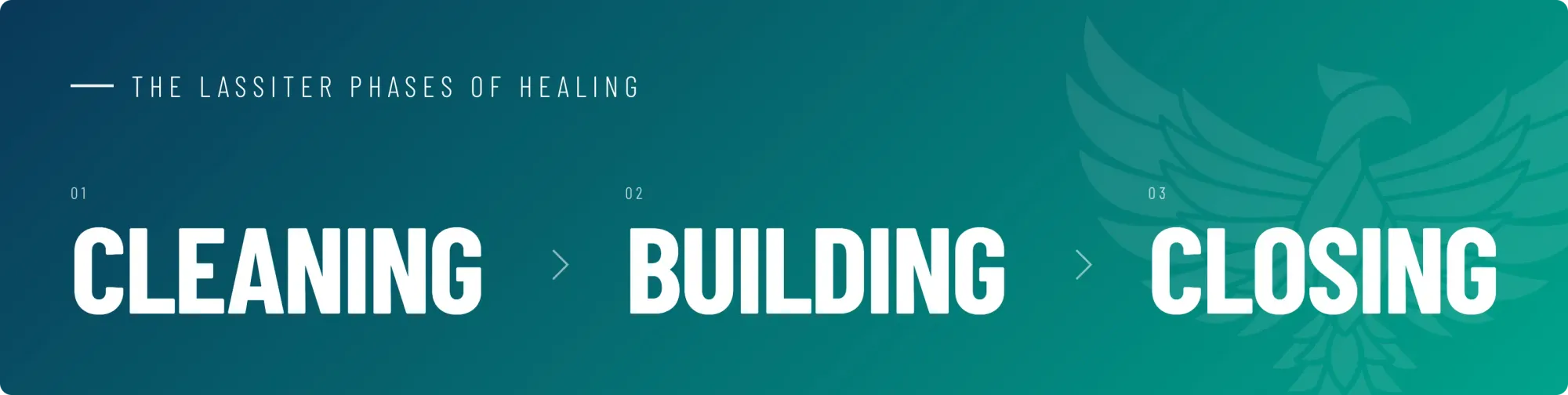
Every wound that heals moves through three phases, in order. I've spent two decades watching this play out on thousands of wounds, and it's consistent enough that I built my whole approach around it. I call it the Lassiter Phases of Healing: Cleaning, Building, and Closing.
The phases matter for a practical reason. A wound gets stuck in one specific phase, not in some general way, and the treatment that helps a wound in one phase can do nothing, or even hold back progress, if the wound is really sitting in a different one.
So, before you can help a stalled wound, you have to know which phase it's parked in. Most of the time, you can tell just by looking, once you know what each phase looks like.
Cleaning
The Cleaning phase is when the wound is still chemically and structurally disordered, and the body is clearing out what doesn't belong before it can rebuild.
What you'll see: slough, drainage, odor, friable tissue that bleeds easily, the signs of a wound still fighting through debris and inflammation.
The job in this phase is to help the wound get rid of what's in the way and get down to a healthy, viable base. A wound stuck here can't build new tissue yet, because there's nothing clean to build on.
Building
The building phase begins once the wound is clean and the inflammation settles down.
This is where the good stuff happens: new tissue fills in, there’s a fresh blood supply, and the wound gets shallower. The tell you're looking for is beefy-red granulation tissue and little tongues of new skin starting to advance from the edges.
The job here is to protect that progress and keep the environment friendly to it. A wound stuck in Building often looks busy, but pale. It seems like it's working, but the tissue isn't healthy, which is exactly what fooled everyone about that woman's ankle we mentioned earlier.
Closing
The closing phase is the final stretch, where the new skin migrates across and seals the wound.
What you'll see is a pale advancing edge creeping inward as the surface closes over. The job here is to protect that fragile new tissue and, just as important, keep correcting whatever caused the wound in the first place. This is the phase people underestimate, because a wound that looks closed isn't the same as a wound that's healed, and if the underlying driver is still there, it'll break right back open.
How to Tell If a Wound Is Actually Stalled
Most of the time, you can tell a stalled wound from a slow one just by looking at it, once you know what the tissue is telling you.
A wound wears its status on its surface. You've just got to learn to read it.
Start with the granulation tissue, the new red tissue filling the wound bed. Healthy, building granulation looks a specific way: moist, a deep beefy red, with a fine pebbled texture, like the surface of a strawberry. That's a wound doing its job. When I see that, I'm encouraged.
The trouble is that not all red tissue is healthy tissue, and this is where a lot of good wounds get misjudged. When granulation turns pale or washed-out, that's a warning, it usually means the wound isn't getting enough blood, enough oxygen, or is carrying too heavy a bacterial load.
If the tissue looks flat and glossy instead of pebbled, that points to a chemical imbalance in the wound or too much bioburden.
And tissue that's overly fragile and bleeds at the lightest touch is telling you there's ongoing inflammation, too much moisture, or repeated trauma.
In every one of those cases the wound looks busy, there's red tissue there, so it seems like progress, but the tissue itself is unhealthy. That's the trap that fooled everyone about the ankle we started with. Pale granulation reads as healing to the eye. It isn't.
Then there's fibrin, the thin, glistening yellowish film you'll often see across a wound. A little of it early on is normal, it's part of the body's first scaffold. But when it lingers as a smooth, uniform, stuck-on coating, it stops helping and starts blocking, walling off the wound and getting in the way of the cells that need to migrate across and close it. Persistent yellow film is not the same as healing, even though the wound may look calmly stable underneath it.
One more visual tell, and it's an important one: the edges. In a healthy wound, the edges are open and sloping, and new skin advances inward across the surface. In a stalled wound, the edges often roll under, thick and curled in on themselves. Those rolled edges mean the skin cells that should be marching across the wound have stopped cold at the border. It's one of the clearest signs that a wound has quit moving.
When you're not sure, measure.
Eyes are good, but they're subjective, and a wound that changes a little week to week can be hard to call.
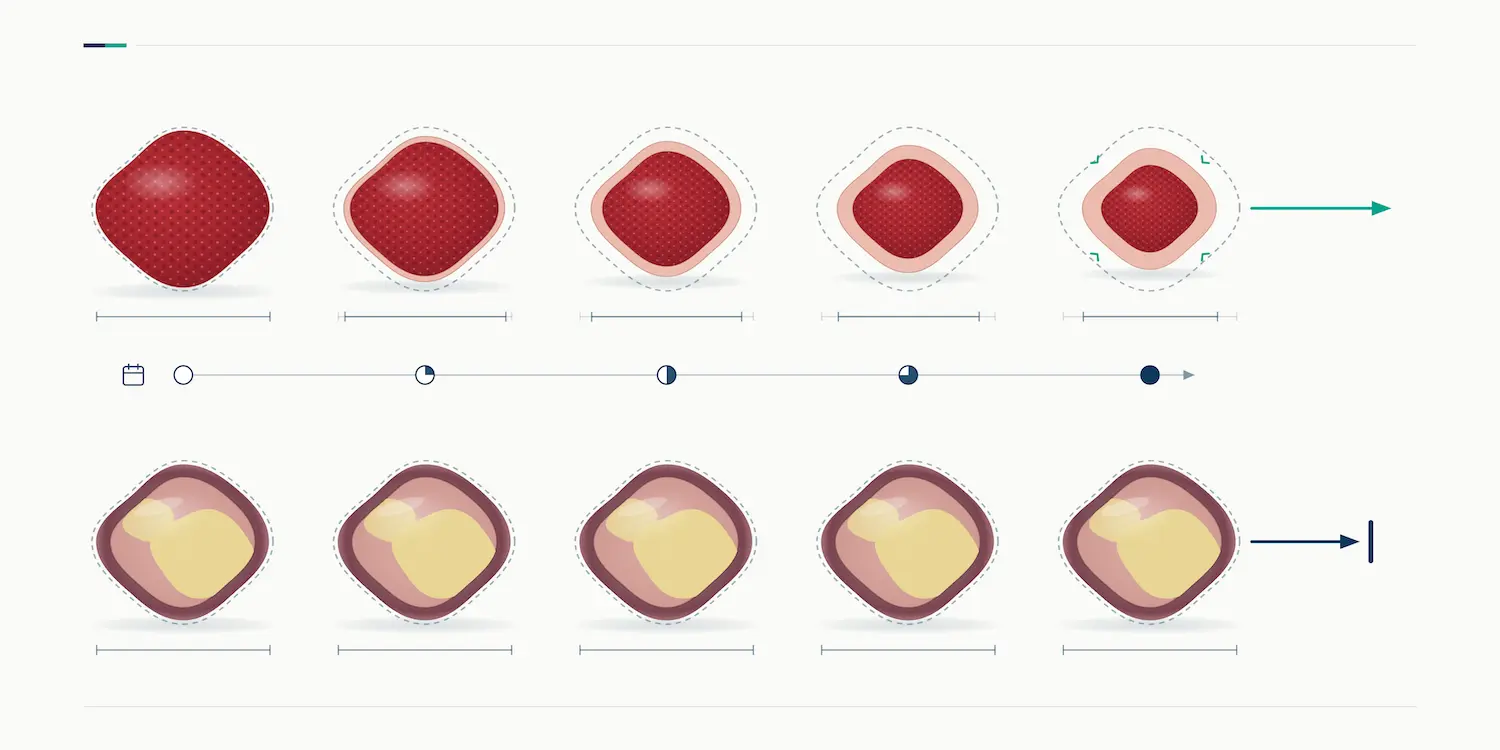
So, there's a simple rule I use to take the guesswork out of it. Measure the wound, then measure it again four weeks later. A wound that's genuinely healing should be roughly 40% smaller over that stretch. If it hasn't shrunk by about 40% in four weeks, that wound is not slow. It's stalled, and something underneath is holding it back that hasn't been dealt with yet.
That number is your line in the sand. It turns a gut feeling into something you can actually act on, and it's the point where watching longer stops being patience and starts being a delay.
Why the Wound Is Stuck: Finding What's Holding It Back

Knowing a wound is stalled is only half the job. The next question is why, and here's the part that should give you some hope: the reasons a wound gets stuck aren't a mystery, and they aren't endless. In my framework, every barrier to healing falls into one of two buckets. I call them wound healing impairment factors, and once you know the two categories, you know where to go looking.
The first bucket is systemic, what I call S-WHIFs. These are the things going on in the body as a whole that starve the wound of what it needs. This is the patient's overall physiology working against the wound.
- Poor circulation that can't deliver blood to the tissue.
- Blood sugar swinging out of control.
- Anemia, so there aren't enough red cells to carry oxygen where it's needed.
- Poor nutrition, so the body doesn't have the raw material to build with.
- The COPD patient whose lungs can't oxygenate a wound bed no matter how good the local care is.
- Smoking
- Kidney disease
- Certain medications, like steroids.
These are the global problems, and a wound sitting on top of an uncorrected systemic issue will keep sitting there, because the body simply doesn't have what it takes to close it.
The second bucket is local, the L-WHIFs, forces acting directly on the wound itself, right there at the bedside.
- Pressure that never lets up on a heel or a hip.
- Edema swelling the tissue and choking off flow.
- A biofilm dug into the wound bed.
- Too much moisture, or too little.
- Infection.
- Even the wrong dressing sitting on the wound day after day.
These are the problems you can often see and touch, and they're acting on the wound directly rather than through the body.
Almost every stalled wound I see is held up by something in one or both of these buckets, and it's usually something that was never identified. That's the reframe that matters: a stuck wound isn't a mysterious failure. It's a wound with an unaddressed cause, and the cause lives in one of two places you now know to check.
What to Do When a Wound Has Stalled
When a wound is stalled, start with what's in your control.
Run down the two buckets like a checklist. On the systemic side, is the patient's blood sugar managed as well as it can be? Are they actually eating enough protein to heal, or do they need a nutrition consult? Is there anemia or a circulation problem that's been noted but not acted on?
On the local side, is the wound genuinely offloaded, is pressure really off that heel, or off in theory? Is edema being controlled with compression if the circulation allows for it? Is the dressing right for the phase the wound is in, or has it been the same product for weeks out of habit?
A surprising number of stalled wounds start moving again once someone works that list deliberately and fixes two or three things that had slipped.
Then give it four weeks and measure. If you've optimized what you can and the wound comes back roughly 40% smaller, then you know it was stuck on something you could reach, and now it's moving. Keep going.
But if you've worked the list honestly and that wound still hasn't budged at four weeks, that's the signal. It means the thing holding it back is something that can't be resolved within the current plan, and continuing to watch it isn't patience anymore.
That's the moment to bring in a wound specialist — and I want to be clear about something, because I see good nurses hesitate here. Calling for a specialist at that point isn't admitting you failed. It's exactly the opposite. It's you recognizing that this wound needs a deeper workup than any care plan is set up to deliver, and catching that early is one of the best clinical calls you can make for that patient.
The referrals I respect most are the ones that come from someone who worked the problem, saw it wasn't enough, and picked up the phone before the wound got worse.
When It's Time for a Wound Specialist
When a wound has genuinely stalled on something the current plan can't fix, that's what a practice like ours is built for. What we bring isn't just another set of hands, it's a different depth of workup.
We run the full framework on that wound: pin down exactly which phase it's stuck in, hunt down every systemic and local factor that's impairing it, and often find the driver nobody had tested for yet. And we bring treatments that go well beyond dressing changes, the therapies and interventions that a wound in real trouble actually needs.
The patient stays yours. We come in as the specialist layer on a wound that's beyond routine care, work alongside your team, and give that stalled wound the focused attention it needs to start moving again.
If you've got a wound that fits what we've talked about here, one that's stalled and not responding no matter how well it's being managed, that's exactly the kind of patient we want to hear about.