Mobile Wound Care Companies vs. Physician-Led Wound Care Practices: What's the Difference?


Across the country, a mobile wound care rep can walk into a skilled nursing facility or home health agency office with clean documentation, a legitimate physician behind them, and real outcomes to show, and still get turned away at the front desk. The person working that desk isn’t being rude — they’re just tired of it.
Tired of the pitches. Tired of the graft salesmen. Tired of hearing, “We’re different” from companies that clearly aren’t different.
That’s the state of the wound care industry today. For better or for worse, the term, “mobile wound care” now carries a negative connotation earned by billions of dollars in Medicare fraud by bad actors over the past five years. These bad actors may have had some success stories, but at the end of the day, they were simply pushing a product to maximize their reimbursements.
We’re hoping to change those generalizations. Wound Care Specialists is a physician-led, multi-state medical practice that specializes in complex wound medicine, limb preservation and hyperbaric medicine. Led by Dr. Lonnie Lassiter, one of the nation’s foremost experts on wound care, our practice makes house calls to wherever the patient calls home. This could be at a skilled nursing facility, or at the patient’s home. It could also be at one of our clinics.
In this article, we want to outline the key differences between the typical mobile wound care companies that may still be out there today and physician-led speciality clinics, like Wound Care Specialists. We’ll explain…
- Why mobile wound care became a red flag for facilities
- How Wound Care Specialists is structured differently
- Who actually directs the care for both types of practices
- What drives revenue in each model
- What charts look like when a wound stalls
- Questions you should ask before referring patients to a wound care practice
Our goal is to build trust and help referral partners and caretakers make the best care decision for their patients.
Why "Mobile Wound Care" Became a Red Flag for Facilities
First, there is absolutely nothing suspicious about treating a wound in someone’s home.
In fact, the “mobile” moniker makes a lot of sense, and treating a chronic wound in a patient’s home is the best path forward for many patients. Patients who need advanced wound care are typically older and have difficulty getting to a physicians’ office every week.
So, how did the term, “mobile wound care” suddenly become a phrase that makes home health administrators and Medicare auditors so apprehensive?
Follow the money.
The Skin Substitute Boom
Skin substitutes (also referred to clinically as cellular and tissue-based products) are grafts used to help close stalled wounds when traditional care isn’t getting the job done.
They are legitimate products, and our providers at Wound Care Specialists use them when it makes clinical sense, but for years, Medicare paid for them using a reimbursement system designed around drugs and biologics.
In a non-facility setting (a mobile setting), Medicare previously reimbursed providers at 106% of the product’s average sales price. When a new product didn’t have the sufficient average sales price data, Medicare could rely on its wholesale acquisition cost (its list price) or invoices to establish reimbursement.
That turned out to be a major problem. Manufacturers could bring new products to the market at an extremely high price — even if it didn’t provide better outcomes — and a wound care provider could purchase that product for substantially less than Medicare’s reimbursement amount through discounts or other pricing arrangements. Medicare still paid the reimbursement rate. The provider paid the manufacturer. And the provider pocketed the difference.
The money that practices were raking in created an enormous financial incentive tied to products and not what was clearly the best healing path for a patient.
In 2019, Medicare Part B spent $252 million on skin substitutes. By 2025, that amount exploded to $18.4 billion.
Thankfully along the way, a handful of bad actors, who received billions of dollars in reimbursements by unnecessarily placing skin substitute grafts, were prosecuted.
Fast forward to today, Medicare changed its reimbursement rules, putting skin substitutes in the same bucket as gauze and other basic wound care supplies, and slashed the reimbursement to $127 per square centimeter (many practices were being reimbursed more than $1,000 per square at the peak of this chapter).
Even with those changes, the bad headlines and fraudulent care left a bad taste in the mouths of many healthcare professionals, and cost accountable care organizations millions of dollars in unnecessary spend.
The Reality of Mobile Wound Care Today
It has not been uncommon in a handful of the states we operate in to be turned away at the desk of referral partners who see us just as another “mobile wound care company.” Unfortunately, the label got attached to a business model — not a care model — that produced several high-profile Medicare fraud cases.
That type of reputation can’t be ignored.
The Attorney General of the United States said the fraud cases exploited “our most vulnerable citizens. Emily Brower, NAACOS President and CEO in October 2025 said, “The deliberate misuse of skin substitutes is endangering America’s seniors” using pricing schemes that undermine Medicare’s overall integrity.
But much of that is behind us today. After Medicare slashed reimbursements and prosecuted the bad actors, skin substitute use dropped and many wound care companies opted to close shop.
Additionally, several good companies with the right care intentions were forced to close because the economics of wound care weren’t sustainable.
So today, we’re left with fewer wound care companies across the country and patients are forced to rely on home health nurses and, ultimately, hospital systems to deal with their wounds. That’s something we see as a ticking time bomb for Medicare. The fewer good people out there who have an expertise in wound care will result in more chronic wounds and, unfortunately, more amputations which carry a huge financial and psychological cost for patients and our healthcare system.
How Wound Care Specialists Is Structured Differently
That’s why at Wound Care Specialists, we’re working to differentiate ourselves from the norm of the past decade. We are physician-owned and aren’t reliant on private equity.
More importantly: We are diagnosis-first and NOT graft-dependent.
We’re a national wound care practice led by one of the nation’s foremost experts on chronic wound care. We treat patients in clinics and we also make house calls.
Again, we don’t let a product dictate a patient’s treatment. We follow the Lassiter Phases of Healing to determine why a wound isn’t healing and then craft a custom healing plan based on our findings. Sometimes, we do use a skin substitute to accelerate the healing process, but only when medically necessary and when it's the best path forward for the patient.
Most of the time, offloading pressure, sharp debridements, and proper patient education around healthy habits is financially responsible and medically appropriate course of action to kick stalled wounds.
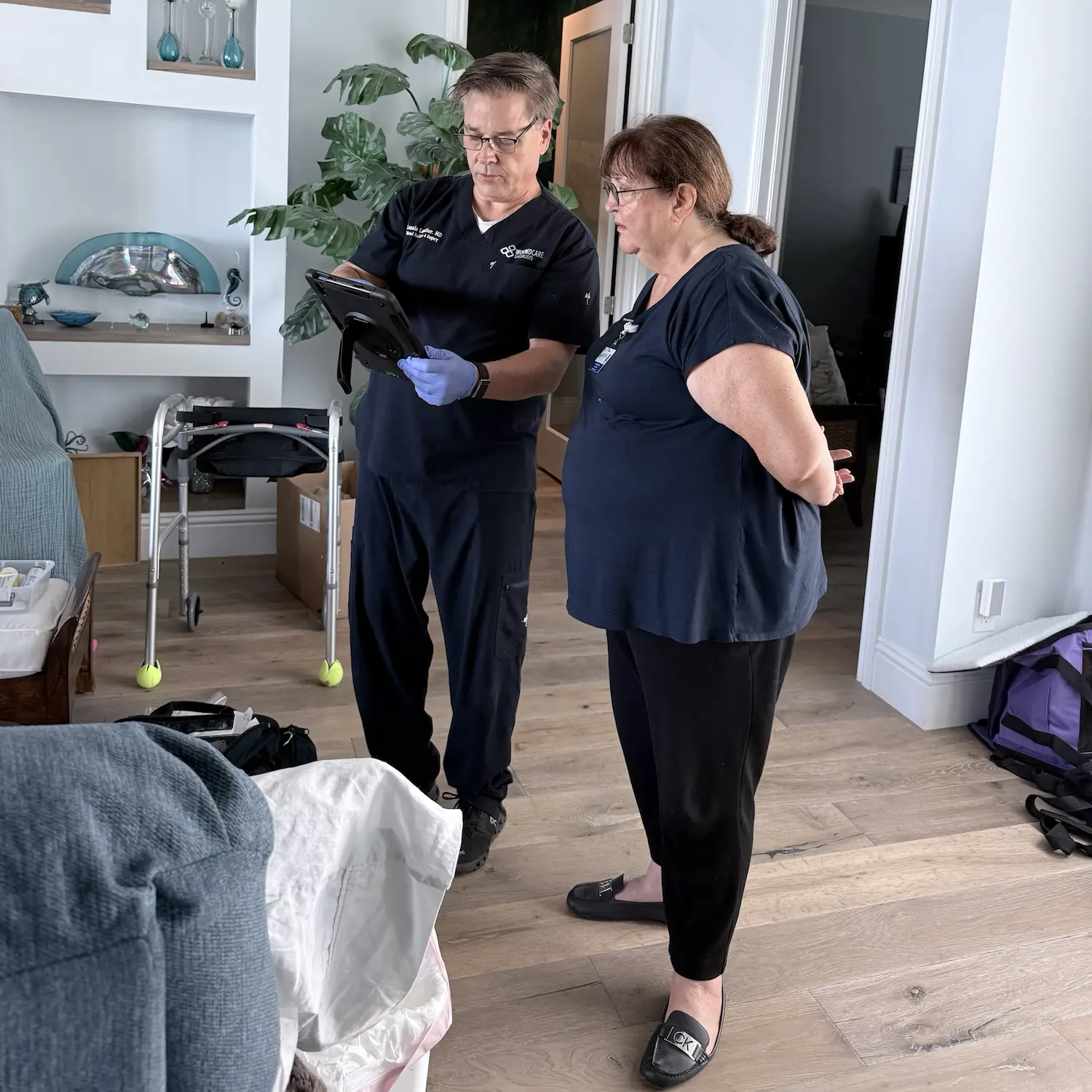
And you will often find our founder, Dr. Lonnie Lassiter, in the field, treating patients, along with our team of skilled nurse practitioners and physician assistants.
Mobile Wound Care Red Flags to Look Out For
As we’ve mentioned, not all wound care companies are necessarily bad and a majority do have the patient’s best interest in mind.
But there are a handful of questions you can ask to determine if a practice is a good fit for your patient or population of patients.
Who Actually Directs the Care?
Many wound care practices are physician-owned, but is that physician actually leading the care?
At Wound Care Specialists, our clinicians are trained by Dr. Lassiter, who also spends significant time across multiple states treating patients.
It’s that level of commitment that gives our referral partners confidence that their patients are in good hands.
Dr. Lassiter has prevented hundreds of amputations over the course of his career and recently published one of the first-ever textbooks dedicated to wound care.
What Drives Revenue in Each Model?
A practice needs to earn money in order to survive. The question worth asking any wound care provider is where the money actually comes from.
We would argue that many of the mobile wound care companies that are no longer around were heavily reliant on skin substitutes. And again, many of these companies only placed skin substitutes on patients when it was medically necessary, and many of them healed a lot of patients. But when a single graft application pays more than a month of physician visits, the graft is the business and everything else is overhead.
Honestly, our model is the boring one. We bill for physician visits at standard Medicare rates that anyone can look up. A visit pays the same whether Dr. Lassiter recommends compression, debridement, offloading, or, when the biology calls for it, a graft. There is no markup on products and no incentive to pick one treatment over another.
That has an honest consequence: modest per-visit reimbursement means we only survive by caring for a lot of patients.
Still, the high skin substitutes reimbursement was the incentive for many practices.
At Wound Care Specialists, we spend the necessary time with as many patients as our capacity allows. So, a high patient volume using proven treatments and tools that address chronic wounds is what drives our revenue.
And the only way a practice like ours gets more patients is when facilities and physicians keep referring them, which only happens when wounds actually close. Our growth depends on our outcomes. We would not have it any other way, because we could not have it any other way.
What Does the Chart Look Like When a Wound Stalls?
Documentation is where the two models separate fastest. When a wound stops improving, a diagnosis-driven chart shows a reaction: new measurements, a vascular workup, a nutrition consult, a changed plan.
A product-driven chart shows the same thing it showed last week. Another application. Similar size graft. Same note, sometimes copied forward word for word.
A stalled wound is information. It is the wound telling you the diagnosis was incomplete. Maybe the arterial supply was never assessed. Maybe the patient's albumin has been dropping for a month. Maybe the offloading plan exists on paper and nowhere else.
A physician-led chart treats the stall as a question to answer. A product-led chart treats it as a billing opportunity that renews weekly.
You do not need clinical training to spot the difference. Pull any four consecutive visit notes and ask one question: did the plan ever change? Wounds are not static, so treatment should not be either. If the wound got worse and the treatment stayed identical, the chart is more or less documenting a subscription.
Questions to Ask Any Wound Provider Before You Sign
Are mobile wound care companies legitimate?
Many are. The problems in this industry came from a specific business model built on skin substitute reimbursement, not from treating patients where they live. The question to ask is not whether a provider travels but what drives their revenue.
What is the difference between a mobile wound care company and a wound care practice?
A practice is a medical entity: a physician diagnoses, sets the plan, and answers for outcomes. A company is a business entity that may deliver clinical services through contracted providers. The chart, not the marketing, tells you which one you are dealing with.
How do I know if a wound care provider is overusing skin grafts?
Look at the sequence. Grafts should appear after conservative treatment has been tried and documented, on wounds that meet clinical criteria, with a plan that changes when the wound does. Grafts applied at the first visit, on every patient, week after week, is NOT a treatment plan.
What should a facility ask before signing with a wound care provider?
Four questions: What do you bill for? Who makes treatment decisions? What happens when a wound stalls? And how do you communicate with our team? A provider with clean economics will answer all four without hesitation.
Work With a Real Wound Care Practice
Every question in this article is one we will answer about ourselves, in writing, before you refer a single patient. Send us a wound that has stalled and see what a physician-led chart looks like.